The Art of Washi: Japan's Sacred Paper
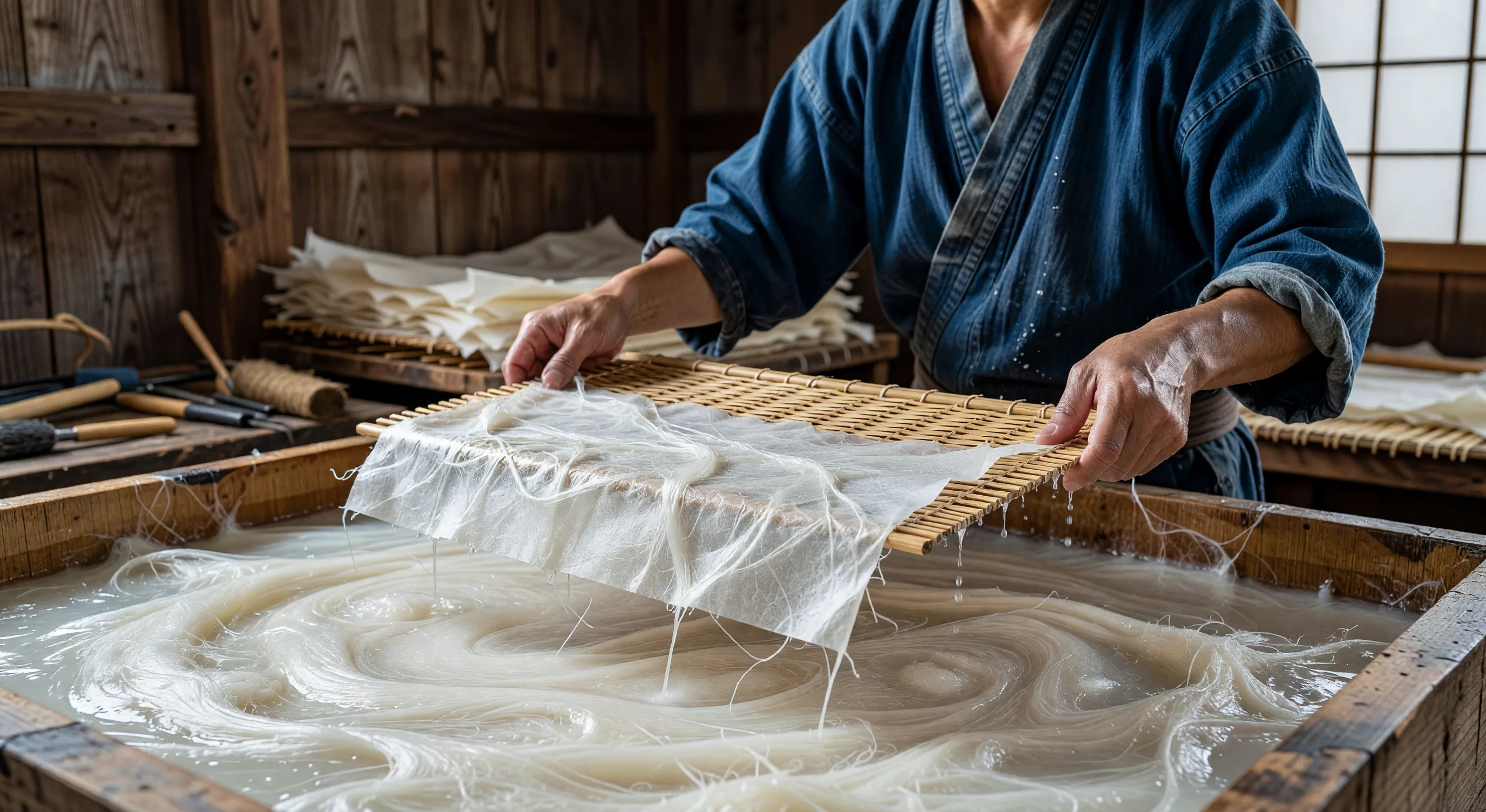
Long before the age of printing presses and digital screens, the Japanese had perfected a paper unlike any other in the world. Washi — whose name simply combines the characters for Japan (wa) and paper (shi) — is hand-made from plant fibres, typically kozo (paper mulberry), mitsumata, or gampi. Its production demands precise knowledge of water temperature, fibre preparation, and the delicate art of the shake — the oscillating motion used to build up an even sheet on the bamboo screen. Each sheet is pressed and dried under careful supervision, emerging with a translucency, strength, and tactile warmth that no machine-made paper can replicate.
The origins of washi in Japan are traced to the 7th century, when Buddhist monks used it to copy sacred sutras. Over the centuries, the craft diversified into hundreds of regional varieties. Echizen in Fukui Prefecture became the established capital of washi production, its sheets prized by court calligraphers and emperors alike. Ogawa-machi in Saitama produced translucent papers for shoji screens. Mino, in Gifu, developed sheets of extraordinary longevity — some washi documents from the Nara period (710–794) survive in near-perfect condition today, a testament to the archival quality that synthetic papers cannot hope to match.
UNESCO inscribed traditional washi craft onto its Intangible Cultural Heritage list in 2014, recognising that it represents not merely a manufacturing technique but a philosophy of making. The papermaker does not fight the fibre; she coaxes it into alignment, working with the natural properties of the plant, the mineral content of the local water, and the seasonal temperatures that affect the fibre's behaviour. A finished sheet of washi is thus a record of a particular place, a particular season, and the particular hands that made it — an irreducibly local object in an age of global uniformity.
Continue Reading